
Aitkin County Arrest Records and Charges
Aitkin County arrest records are law-enforcement and custody records. They may show that a person was arrested, booked, held, released, or listed on the jail roster. The Aitkin County Sheriff's Office operates the jail and dispatch center, while the court case record is handled by Minnesota District Court. That split matters because an arrest is not the same thing as a filed court charge, and a jail roster entry is not the same thing as a final criminal judgment.
The charge record begins when law enforcement issues a citation or sends investigative material to the Aitkin County Attorney's Office for a charging decision. If the prosecutor decides the evidence supports charges, a criminal complaint is drafted and signed by a judge. The District Court case then tracks the charge, hearing dates, pleas, amendments, dismissals, and final disposition. For current custody and booking context, use the Aitkin County inmate roster; for the full case file and sentencing record, use Aitkin County criminal court records.
The County Attorney victim services page is a helpful source for the prosecutor's role because it states that the office prosecutes felony, misdemeanor, and juvenile crimes in Aitkin County. It also notes that criminal cases are brought by the State of Minnesota, not by a private victim who can personally press or dismiss charges.
Aitkin County Attorney victim services explains the office's prosecution and victim-rights role in local criminal cases.
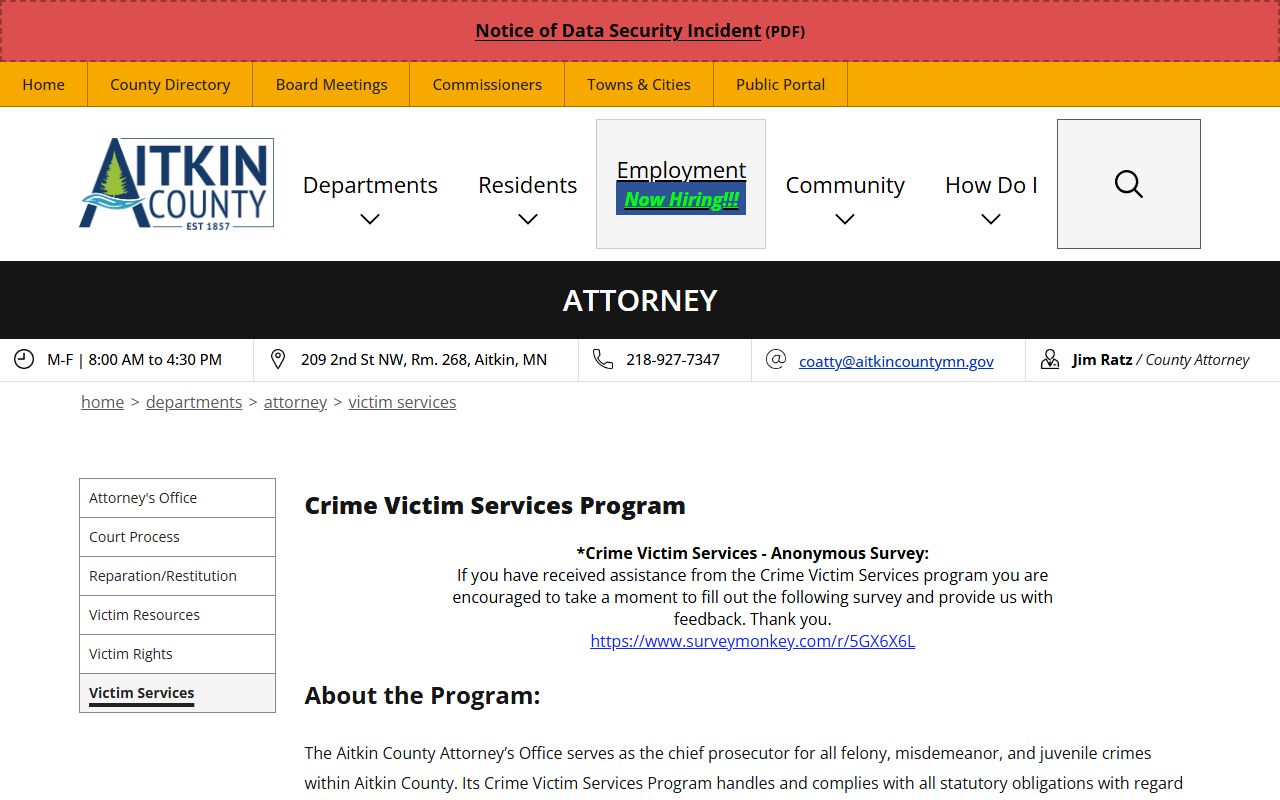
That source is useful when reading charge records because it confirms the prosecutor, not the arresting officer alone, controls the filed criminal case.
Search Aitkin County Arrest Records and Charges
There is no single official Aitkin County mugshot database for arrest records and court charges. The practical search path uses the jail roster for custody, Minnesota Court Records Online Case Search for filed District Court charges, and the Minnesota BCA Public Criminal History Search for public conviction-oriented criminal history. MCRO is statewide, so select Aitkin County under court location when narrowing a name search.
- Check the Aitkin jail roster if the question is current custody, booking date, holding agency, or listed jail charges.
- Search MCRO by name, case number, or citation number to find filed criminal or traffic charges in Aitkin County District Court.
- Open the public Register of Actions and review the charge list, hearing entries, complaint filings, plea events, and disposition lines.
- Contact Court Administration if a certified copy or official answer is needed, because MCRO search results are not certified records.
- Use the BCA criminal history search for public criminal history data, while keeping it separate from a live court-charge lookup.
MCRO has important limits. Pending criminal, traffic, and petty misdemeanor cases with no conviction may not return in a defendant-name search, even when a case exists. Case-number searching can be more reliable when a citation, complaint, or calendar entry provides the number. Domestic abuse, harassment, juvenile, civil commitment, and sealed records can also be limited by Minnesota public-access rules.
Aitkin County Community Corrections is part of the local case ecosystem when charge records later show probation, review hearings, or violation proceedings.
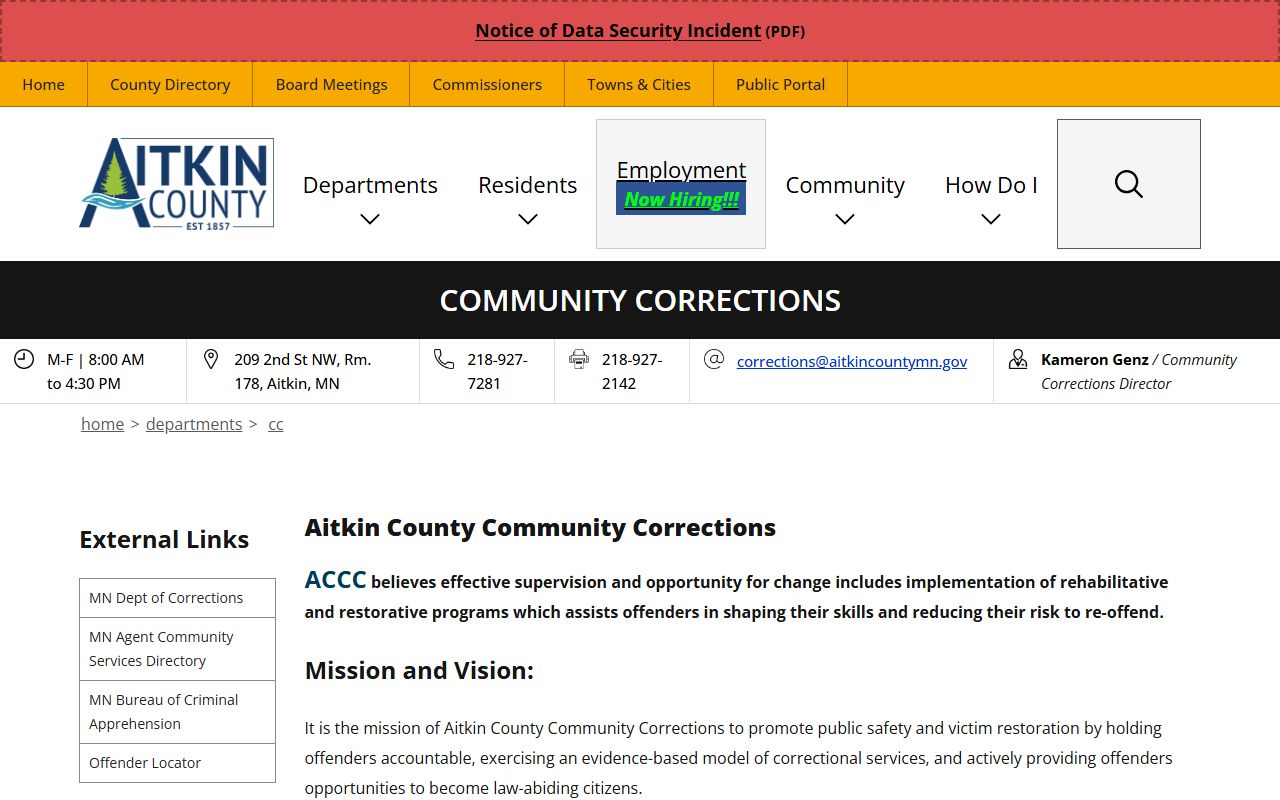
Community Corrections does not replace the court record, but it helps explain later supervision entries that may appear after conviction or a probation violation allegation.
Aitkin County Court Charges After Arrest
Court charges after arrest in Aitkin County are shaped by Minnesota charging practice. The research supports three local pathways: an officer may issue a citation, an officer may submit materials to the County Attorney for review, or the prosecutor may draft a criminal complaint for judicial signature when evidence supports probable cause. The template term "information" and "indictment" should be read carefully here. The researched Aitkin process centers on citations and criminal complaints, with serious felony charging still governed by Minnesota criminal procedure and court rules.
| Charging document | How it fits Aitkin County records | Where to verify it |
|---|---|---|
| Criminal complaint | Prosecutor-drafted charge document signed by a judge when enough evidence supports probable cause. | MCRO Document Search by case number or Court Administration. |
| Citation | Written charge or ticket that may start a traffic, petty misdemeanor, misdemeanor, or related court file. | MCRO Case Search by citation number or case number. |
| Prosecutor charging decision | County Attorney review of law-enforcement reports before filing, declining, amending, or adding charges. | County Attorney court-process materials and the District Court case record. |
The Minnesota Board of Public Defense office listing matters when a defendant needs counsel after charges are filed in District Court.
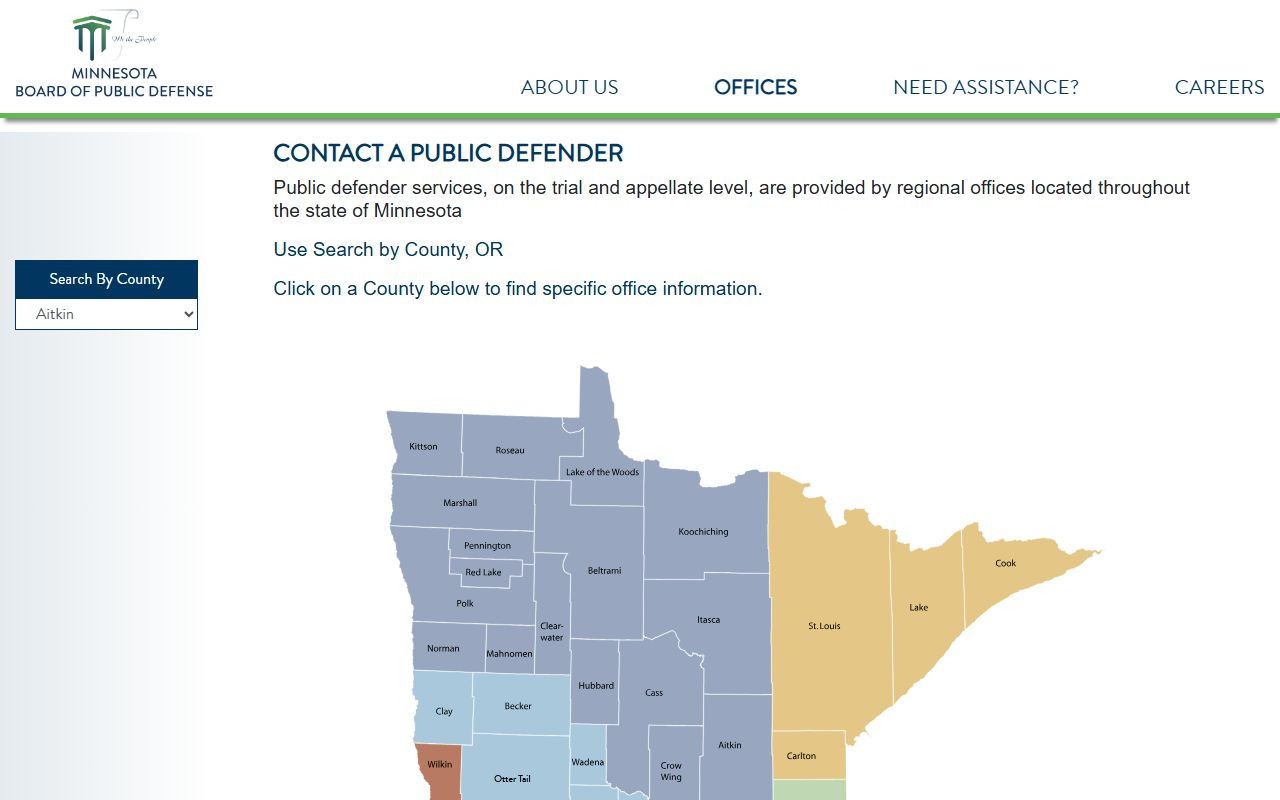
Public defender eligibility is reviewed by the court, so appointment information belongs with the court case rather than with a jail booking entry alone.
Aitkin County Charge Status Terms
A charge status describes where one count stands within the court case. One arrest can produce several counts, and each count can move in a different way. A charge may remain pending, be amended to a different statute or severity, be dismissed, or end in a conviction after a plea or verdict. Minnesota records may use disposition wording and Register of Actions entries rather than a simple "active/inactive" label on each charge.
| Status | Meaning in an Aitkin County court-charge record | Common place to check |
|---|---|---|
| Pending | The charge is still open, with no final disposition entered for that count. | MCRO case activity, hearing calendar, or Court Administration. |
| Amended or reduced | The prosecutor changed the charge, statute, severity level, or count before final resolution. | Register of Actions and charging documents. |
| Dismissed | The court record shows the count was not carried forward to conviction. | Disposition lines, orders, or hearing minutes. |
| Convicted | A guilty plea, guilty verdict, or other conviction disposition was entered. | Disposition and sentencing entries. |
| Probation violation | A later allegation that supervision terms were violated, often after a conviction or stayed sentence. | Criminal case docket and calendar entries. |
Note: Minnesota MCRO records are unofficial online records; certified copies must come from local Court Administration.
Aitkin County Charges vs Convictions
Aitkin County arrest records and charge records should not be read as proof of guilt. A charge is an allegation filed in court. A conviction is an outcome after a plea, verdict, or other legally recognized adjudication. A person can be arrested and never charged, charged and later dismissed, or convicted of a different offense than the original complaint listed.
| Point of comparison | Charge | Conviction |
|---|---|---|
| Record stage | Filed after citation or prosecutor charging decision. | Entered after plea, verdict, or qualifying adjudication. |
| Meaning | Alleged violation of a Minnesota statute or ordinance. | Final finding that the offense was proved or admitted. |
| Where it appears | Complaint, citation, charge list, and hearing record. | Disposition, sentence, judgment, and BCA public history when reportable. |
| Risk of misreading | Can be amended, reduced, or dismissed. | May still be sealed or expunged if Minnesota law allows. |
Public Access to Aitkin County Charge Records
Public access depends on the record holder. Court charges are Judicial Branch records governed by Minnesota court access rules, so the starting point is MCRO or Aitkin County Court Administration. Sheriff booking data, incident reports, booking photos, or jail records not in the roster are county executive-branch data, so the fallback is the Aitkin County Data Practices process directed to the Sheriff's Office or the department that keeps the data.
Minnesota Statutes section 13.87 governs dissemination of criminal history data and is the authority cited for public criminal history access through the BCA. Minnesota Public Access Rule 4 lists court records that are not public. Minnesota Public Access Rule 8 explains remote access limits, which is why some records may be public at a courthouse terminal but absent from MCRO.
Important: Do not use a pending charge record as a conviction record unless the court disposition actually shows conviction.
Minnesota criminal history data law is one of the key sources for understanding how charge and conviction data may be released.
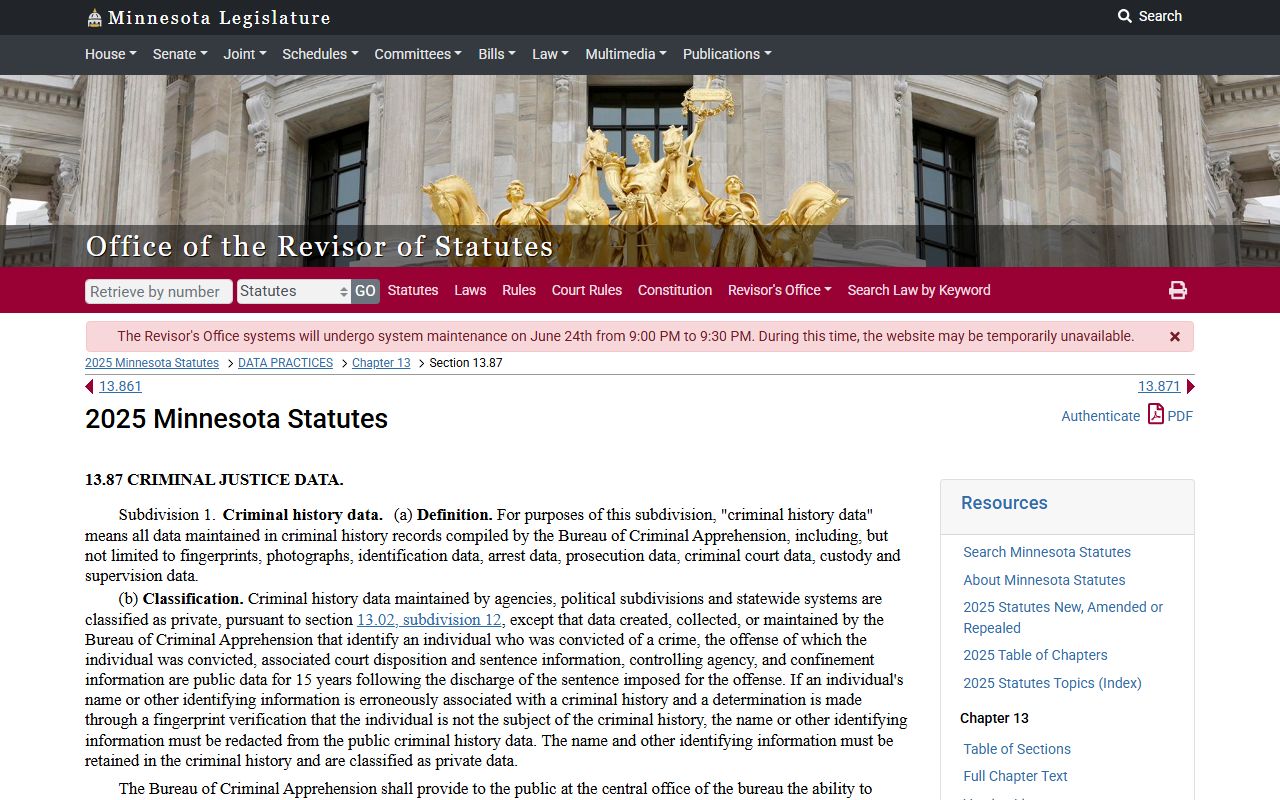
The statute helps separate statewide public criminal history data from the more detailed local court file and jail records.
Restricted Aitkin County Arrest Records
Some Aitkin County arrest records, court charges, and case documents are not available remotely or are not public at all. MCRO excludes or limits several categories, including domestic abuse/order-for-protection and harassment-restraining-order case types, CHIPS, juvenile felony 16 matters, and public documents in civil commitment case types. Street addresses and general comment fields are also not displayed online.
Expungement is a sealing process, not a promise that all agencies erase every trace at the same time. Minnesota chapter 609A can apply to arrest, indictment, trial, verdict, and related records when the legal grounds are met. A granted expungement seals the record from ordinary public access, but access may still exist by court order or statutory authority. Aitkin filings go through Minnesota District Court, with local questions handled by Court Administration.
| Record condition | Effect on public access | Aitkin County access point |
|---|---|---|
| Sealed or expunged | Hidden from ordinary public searches unless law or court order allows access. | District Court / Court Administration. |
| Juvenile or CHIPS | Restricted by court access rules and party status. | District Court, not a public web search. |
| Pending nonconviction case | May not appear in MCRO defendant-name search. | Search by case number or ask Court Administration. |
| Sheriff investigative data | May be public, private, confidential, or temporarily nonpublic. | Sheriff/Data Practices request. |